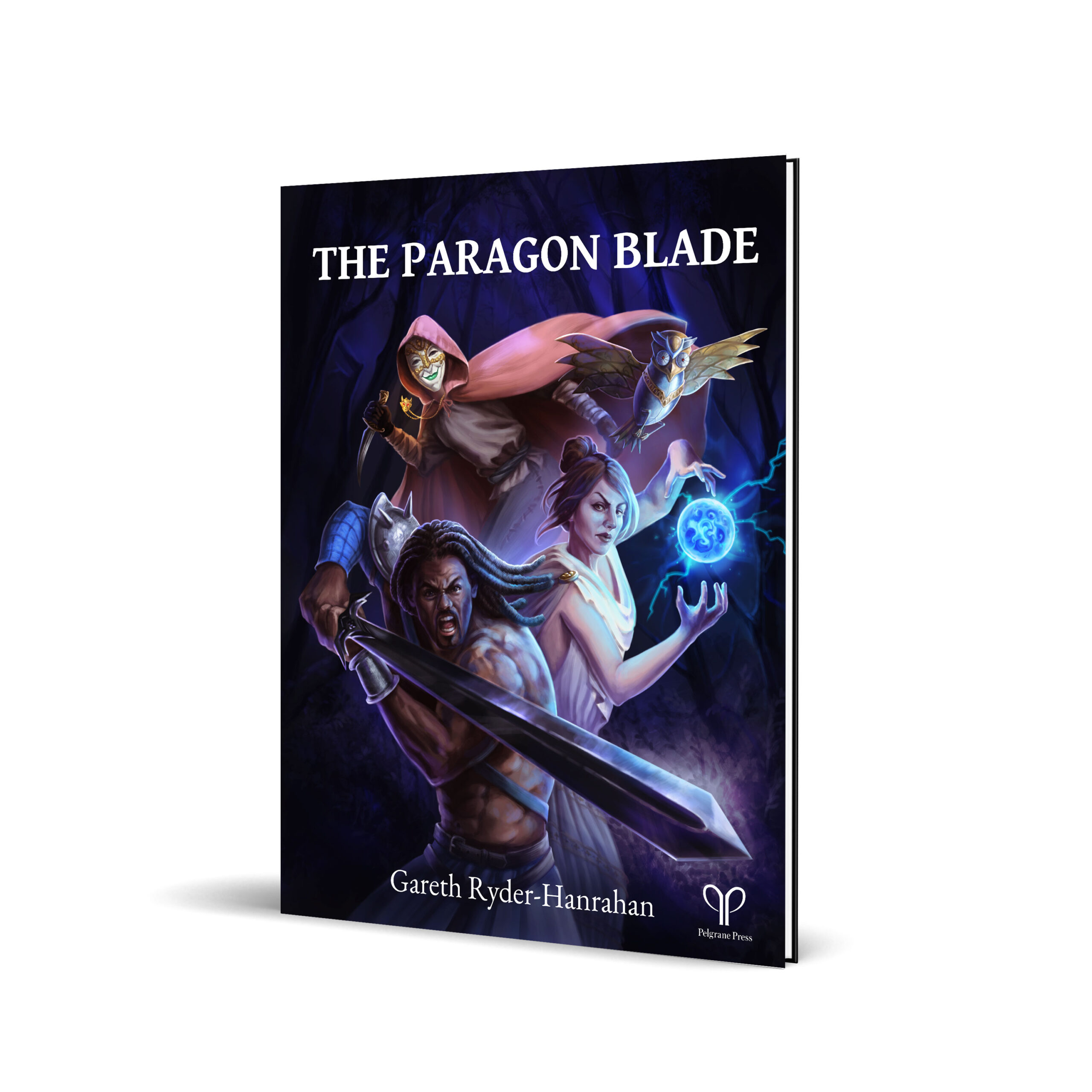

Christian is very close to being finished with the layout for Hillfolk, and it’s really capturing the feel of the game. We’ve also had a picture from the printers of one of the bags for the Hillfolk tokens. Here are some initial mock-ups of how the books, the cards and the bag will look.
Talking at Yourself
by Robin D. Laws
Experienced GMs know to avoid situations in which multiple NPCs carry on a conversation. These conversations with yourself are hard for GMs to sustain and for players to follow.
Most of the time you can engineer events so that this doesn’t happen. If one or more PCs are present in the scene, you can have one of the NPCs draw them into the discussion. This slices up a group scene into mini-scenes, mostly between an NPC and at least one PC.
Let’s say the king and his chancellor, both NPCs, are conferring to decide what to do about the bandits up north. The party stands by as they hash the issue out. The king prefers caution; the chancellor, decisive action. Express this not with long snippets of dialogue from each, but with leading questions that draw the PCs into the scene.
The chancellor might throw the question to a hotheaded player character: “Sir Eobald, I see you champ at the bit to put down that impudent rabble!”
The king might address the most cautious of the player characters: “Cedric, I see the rashness of Eobald’s proposal disturbs you.”
This allows you to establish the king’s reluctance and the chancellor’s hard line, without having them speak much at all to one another.
If you find yourself having to avoid these scenes often, take it as a sign of a larger problem. It suggests that you’re letting your own supporting characters upgrade themselves to protagonist status and drive the plot. It implies that the PCs have become spectators. The process of putting them back into dialogue is just part of the broader objective: to return them to a central place in the storyline. Give them the power to move events. Have powerful NPCs work through them, giving them the leeway to make the key decisions that propel the narrative. Think of the NPCs as supporting characters who bring out aspects of the main cast, whether as foils or antagonists.
Still, sometimes you’ll find events pushing you toward inter-NPC dialogue.
In many cases you can simply keep the conversation brief, boiling it down to a couple of sentences per NPC. Dialogue sequences in roleplaying games go on for much longer than their equivalents in fiction. As we improvise them, we repeat ourselves, include placeholder pleasantries as we buy ourselves time to think, and fumble around in pursuit of the main point. In other words, we speak like we do in real life. Screenwriters in particular compress dialogue to the essential core, leaving in only as much of this extemporization as needed to make the words feel real. Do the same when forced to stage a self-conversation. Unlike a scene between you and a PC, or two PCs, you know what both characters want and what the upshot of the conversation will be. You’re improvising the words but know the outcome already. So compress like a screenwriter and get to it in as few words as possible.
But let’s say the premise of the scene calls for an extended conversation. A PC might be eavesdropping on two NPCs without their knowledge, preventing you from having the supporting characters acknowledge them and draw them into the dialogue. Player characters might listen to an already recorded conversation. Or the story might take you to a situation where it strains credibility for the NPCs to care about what the PCs have to say—for example, when a conversation occurs between two jailer NPCs keeping them prisoner.
A simple trick allows you to turn even these seemingly closed conversations into exchanges—not between characters, but between you as the GM and the players.
Elide these conversations the same way you would the details of a long journey, with summary narration instead of dialogue:
- “The king and chancellor argue for a long time about your usefulness to the court, and whether he should risk your lives sending you up against the bandits.”
- “On the tape, Chu and Big Head discuss a laundry list of triad business, most notably the pressure from the mainland cops to replace the rotating leadership with a single gang leader handpicked by them.”
- “Your captors, clearly not suspecting that any of you speak their tongue, mostly make bored small talk about this crappy assignment and the pleasurebots back on Araatis Station. But they do let slip some guesses about the coming succession war.”
- “Each of the cultists rises to toast Ephraim on the occasion of his one hundredth birthday. Bloch speaks wittily, Howard with inebriated gusto, while Derleth gives a fussy genealogical discourse. Smith finishes with a poem of cosmic insanity that sends you reeling, blood dripping from your left ear.”
These recaps invite the players to then ask for more details, which you can answer on a Q&A basis, in GM-to-player mode:
Ken (a player): Did they mention the name of the mainland cop?
You: It didn’t seem like they knew.
Ken: Any idea from the tape who might know?
You: Big Head was passing on gossip from his boss.
Ken: (consulting his notes) That’s Uncle Bell, right?
You: Yep.
Ken: Any idea where this mainland cop operates from?
You: Big Head says that Uncle Bell just got back from Guangzhou.
Carrie (another player): Do they say anything about who hit Uncle Gong?
You: Both agree that it was an inside job, but Chu thinks it was a spontaneous mutiny, while Big Head says they must have been paid off by Wai.
Daniela (another player): Do they say anything else interesting?
You: They mostly talk about the leadership situation and the pressure from the mainland. Anything else you’re looking for?
Sometimes conversations between NPCs just provide flavor, as in the above case of the toasting cultists. But if a player does come up with an interesting question, the answer to which would move the scenario onward, you can improvise an answer to it.
When you have preplanned information to impart, make sure to imply a clear line of questioning the players can pursue to get it out of you. Otherwise your solution to the talking to yourself problem mutates into another classic dilemma, the pixel-hunt.
This month’s topic comes courtesy of “Professor” Ken Thronberry, as a perk of his Badlands Overlord reward tier from the Hillfolk Kickstarter. Thanks for the great question, Ken!
After much preparation, a great leviathan lurches its head from the dark waters of podcasting. Ken and Robin Talk About Stuff, the new podcast featuring Pelgrane Press stalwarts Kenneth Hite and Robin D. Laws, is now live. Bookmark its popping site, as festooned by the finest cartoon stylings of John Kovalic, whose Dork Tower is a Ken and Robin sponsor in perpetuity. Ken and Robin will range far and wide across the fields of gaming, history, movies, culture, and time itself. But given their various works in progress, you can expect regular scoops, hints and insider skinny on all things Pelgrane. Listening to the podcast will refresh several of your investigative ability pools, guaranteed.
Grab the inaugural episode to hear us discuss Night’s Black Agents, English perambulations, the role of the GM in contemporary game design, and the Hermetic Order of the Golden Dawn.
by Robin D Laws
The GUMSHOE rules break with roleplaying tradition in several notable ways. Most obviously, its information gathering skills, here called investigative abilities, default toward automatic success, with a point-spend mechanism to allow for extraordinary successes and additional benefits.
Also, its general abilities—those governing activities where failure is as likely to lead to an interesting plot development as success—don’t much concern themselves with the simulation of a measurable reality arising from the characters’ capabilities. Instead they allow players a strong but uncertain control over when their characters succeed and fail.
This approach emulates the structure of procedural ensemble fiction, where each of the main characters gets a number of chances to shine per story. The clearest model for this appears in episodic TV. Over the course of a series, if not in every episode, key characters receive a roughly equal number of spotlight moments, in which they overcome major obstacles in a cool and compelling way. Each character does this in accordance with his or her key traits or abilities.
GUMSHOE general abilities port this narrative convention into roleplaying. You get X opportunities to shine per scenario, where X is a somewhat fuzzy and unpredictable number. Your character may shine with an atypical ability, but more often than not triumphs by employing the abilities most associated with her.
When creating your character, envision the sorts of victories you want your character taking part in, and allocate your build points to the abilities that best suit those moments.
If the mechanics seem weird to you, you are probably applying the simulative thinking of other fine rules systems to GUMSHOE, resulting in a classic expectations mismatch.
Your character does not, for example, become literally worse in her abilities as you spend points[1]. Ratings remain unchanged as you spend points. Point-spending is something players do on the fictional level, not something that happens to the characters in their reality.
If your Athletics rating is 8, you are better, overall, at performing physical tasks than a teammate with an Athletics rating of 4. When making a pound-for-pound comparison, always use ratings, not pools.
However, if you’ve already spent 4 points, and your teammate has spent none, you now have a roughly equal chance of successfully performing Athletics-related tasks until the next refresh occurs. But you already have one or two successes under your belt, most likely, while he hasn’t done anything to demonstrate his athletic prowess. You have already shown yourself to be the superior athlete by overcoming obstacles using your Athletics. All else being equal, you will be the superior athlete more often than a character with a lower rating.
Variables may muddy the waters. You might spend low and roll low, losing when you thought you would win. Obstacles you tackle might present higher Difficulties than those lower-rated fellow PCs dare to confront. But over time, you will rack up more key moments with your higher rating.
In fiction, character is action. In procedural fiction, in which the characters face obstacles external to themselves, what counts is how often you win, and how. Your characters’ bad-assedness is established not by the number still sitting in your pool column, but by your achievements so far.
GMs can assist in this perception by describing unexpected setbacks not as a failure of the character’s abilities, but as the result of external complications. Scotty doesn’t suddenly forget how to fix the Enterprise. But he may be delayed by ion interference—especially if he already got the ship out of a big jam earlier in the episode. Now it’s Kirk’s turn to solve the problem using his key abilities, or maybe Spock’s.
The die rolling component of tests, twinned with the concealment of Difficulty numbers, introduces the uncertainty, and therefore the suspense, needed to balance players’ dual roles as authors and spectators. In the mainline roleplaying tradition, you control your character to some extent, but are anxious for his success at various intervals. GUMSHOE tips the balance a little more towards the author side, by letting you pick your successes. But it maintains tension by introducing doubt to any general ability outcome.
In real life, the results of important decisions remains unknowable until we make them. Compelling fiction works the same way. When viewpoint characters take action, we hope for their success and fear for the consequences of possible failure. This happens in most roleplaying games when a die is rolled. GUMSHOE ratchets the tension up a notch by adding a tough decision point on top of that.
Uncertainty comes, in part, from never knowing how many times you’ll need a given ability in the remainder of the scenario. Knowing that the base Difficulty is 4, you will often be right in deciding how many points to spend, should you decide to. But both decisions remain at least somewhat fraught. If it makes you a little anxious, it is doing its job.
The added anxiety suits the genres GUMSHOE chooses to address: the gritty space opera of Ashen Stars, the deglamorized super-heroics of Mutant City Blues, and the horror of The Esoterrorists, Fear Itself and Trail of Cthulhu. If you’re playing the latter and complaining about a mechanism that confronts you, just a touch, with the essential unknowability of human existence, perhaps you need to go back and reread “Supernatural Horror In Literature.”
GUMSHOE has always adjusted its basic parameters to the needs of each game. Should we someday get the license for Care Bears Mysteries[2], we’ll surely dial down the point-spend uncertainty principle.
Until then, you can never be sure at any moment that you’re spending the absolutely right number of points on any given action. But you can ask yourself how much you want this particular triumph, and spend accordingly. Not with your calculating head, but with your storytelling gut.
By Robin D Laws
Though most players find GUMSHOE simple and straightforward, we’ve heard from a few folks who’ve had trouble assimilating it. Usually this happens when they see that it’s a little different from the roleplaying rules they’re used to, and then assume that it’s even more different than it really is. Here are the questions we tend to get from players as they grapple with GUMSHOE, along with the answers that helped them make the adjustment. Use these to guide any of your players who haven’t yet had the cartoon lightbulb of recognition appear above their heads.
Doesn’t the game railroad the players down a single path?
No more so than any other investigative game in which the players attempt to unravel a mystery whose answer the GM has determined in advance. (Nor do you have to determine it in advance) If the only source of narrative branches in a scenario is the possibility that the PCs will fail to understand what’s going on, it’s already a railroad. For this reason, GUMSHOE actually allows you to see the clue path more clearly and construct it to avoid single-track plotting. You do this by ensuring that there are multiple paths to the eventual solution.
In many instances, the feeling that players enjoy freedom of decision-making matters more than the actuality of your plot diagram. A story replete with chances to fork the narrative in unexpected directions may feel like a railroad if the players feel pressured or constrained. Conversely, a single-track plot might feel free and open if they feel that they’re forging ahead and you’re scrambling to keep up with them. When players feel hemmed in or see only one undesirable way forward, the GM may need to point to their various options, showing them that they’re not being railroaded.
Won’t the players just rattle off all of the abilities on their character sheets every time they enter a scene?
No more so than in a game where you have to roll against your abilities to get information. Players who imagine this happen are assuming a much greater difference between the traditional style and the GUMSHOE approach than actually exists. In each case, players always have to describe a logical course of action that might lead to their getting information, directly or indirectly suggesting the ability they use to get it. In the traditional model, there’s a roll; the GM supplies the information on a success. In GUMSHOE, this step is skipped—but it’s the only step skipped.
Traditional style:
Player: I scan the area for unusual energy signatures.
GM: Roll Energy Signatures.
Player: I succeed.
GM: You detect a harmonic anomaly on the quantum level—a sure sign that Xzar technology has been used here, and recently.
GUMSHOE style:
Player: I scan the area for unusual energy signatures.
GM: [Checks worksheet to see if the player’s character has Energy Signatures, which she does.] You detect a harmonic anomaly on the quantum level—a sure sign that Xzar technology has been used here, and recently.
In neither style do you see players grabbing their character sheets as soon as they enter a new scene and shouting out “Anthropology! Archaeology! Botany! Cybe Culture! Evidence Collection!” They don’t do this because it would be weird, boring, and stupid—and because in neither case does it fill all the requirements necessary to get information from a scene.
The only difference is the lack of a die roll. It has a big effect on play, but that doesn’t mean you’re suddenly taking the express train straight to Crazytown.
What if the players come up with a different way to get the information than the scenario specifies?
Give it to them. GUMSHOE always provides at least one way to get clues into player hands. Reward player creativity when they find others. Disallow this only where it:
- pushes aside another player who ought to be able to use an ability he’s heavily invested in to get the info, and who would be upset to see his spotlight stolen
- makes no fricking sense whatsoever
In the latter case, work with the player to suggest a more plausible means of using the proposed ability to acquire the clue in question.
In some cases, an unorthodox ability use might require a spend or trigger some negative consequence in the story. In general, though, GUMSHOE is about allowing access to information, not disallowing it. The default GMing style handed down by oral tradition from the hobby’s early days trains us to be on the lookout for actions to disallow. GUMSHOE works best when you always look for ways to say yes.
How hard should I hint if the players are floundering?
As much as you have to, and (ideally) no more.
The barrier we traditionally erect between player autonomy and GM intervention is like any other roleplaying technique—it’s useful only insofar as it makes our games more enjoyable. In GUMSHOE or any other system, frustrated players are generally happy to be nudged back on track, even if you use techniques that would otherwise seem intrusive. Hint as unobtrusively as you can, but hint all the same. When possible, disguise your hinting by using the mechanisms the game provides you. In this case, use your Investigative Ability Worksheet to find an ability that would logically provide the insight needed to see past the current roadblock. Then narrate it as if the character who has the ability has had a hunch or breakthrough:
“Suddenly you remember the phrase your Forensic Accounting professor kept hammering into you: follow the money!”
[Industrial Design] “Maybe it’s the engineer in you, but you can’t help thinking there’s something about that schematic you missed the first time around.”
[Interrogation] “It occurs to you that maybe it’s time to take somebody into custody and ask a few tough questions.”
The extent to which you subtly usher the players along is also a pacing issue. What seems intrusive and railroady in the middle of a session may feel satisfyingly efficient as the clock ticks down toward the end.
What are the common causes of player floundering?
Stopping to ask why players are stuck is the first step to hinting them out of their conceptual paralysis. A few common syndromes lie behind most floundering incidents:
Problem: Someone already came up with the right, simple answer, but it was dismissed or forgotten.
Solution: Tell the group that they’ve already considered and dismissed the right answer.
Problem: The group is stuck in endless speculative mode.
Solution: They need more information. Remind them of this basic investigative principle.
Problem: The group knows what to do, but is too risk-averse to proceed.
Solution: Tell them to nut up. That’s why they get paid the bigcreds.
What if players over-investigate every little detail?
Expect players to surprise you by applying their investigative abilities to tangential descriptive details. For example, as the players explore a palace on a Tudor synthculture world, you might mention that a medieval-inspired tapestry hangs over a wooden throne. The core clue is a residue of alien protoplasm on the bottom of the throne. You mentioned the tapestry simply to add another evocative detail. Now your players are asking you what’s on the tapestry, whether it’s antique or modern, and whether the star pattern shown in its sky tells them anything.
A useful clue that dovetails with the episode’s central mystery might occur to you here. If not, though, you can still treat this as more than a null moment to be quickly dismissed. Instead, treat tangential queries as opportunities to underline the characters’ competence, while at the same time signaling that they have no great relevance to the case at hand. You can do this simply with a “no big deal” tone of voice or body language, or you can spell it out explicitly.
[Astronomy] “You can recall a thousand star systems from memory, and can say right away that the pattern of stars is just an arbitrary pattern chosen by the artist.”
[History, Human] “The images depict an idealized image of Henry VIII—exactly what you’d expect from someone who didn’t bother to delve into the actual history.”
[Chemistry] “What’s it made of? The usual synthetic fibers, exactly as you’d expect.”
What if the player actions suggest a clue that isn’t in the written scenario?
This will happen all the time. No scenario, no matter how tightly written, can provide every answer to the questions players will use their abilities to ask. When this comes up:
Using your knowledge of the scenario’s backstory, think up the most logical answer to the question.
- Pause to make sure that your answer doesn’t contradict either the facts needed to supply the solution to the ultimate mystery, or any of the core clues along the way. If it does, modify it to fit the rest of the mystery.
- Supply the info. This might lead to new scenes and alternate ways of gathering the core clues. Improvise as needed to keep up with player actions.
Doesn’t the clue structure make the game hard to prepare for, or to run on the fly?
It’s true that good mysteries are hard to plot, in roleplaying or in other media. You have to be able to plot in two directions, creating both a logical backstory that makes sense when reconstructed, and (as a bare minimum) at least one logical path for the investigators to follow when unraveling it. However, if you keep the backstory reasonably simple, you can rely on the players to provide all the complications and red herrings you need. With this in mind, preparation for a game session can be as easy as jotting down a few point form notes sketching out the backstory and scene structure. Provided you keep the basic details and story logic straight in your head, this very basic structure makes plotting easier, not harder.
In this case, you’re in luck: space opera conventions mean that Ashen Stars mysteries can be simpler than those in police procedurals or horror games.
In my group, we never see the game ground to a halt on a missed information roll, so why play GUMSHOE?
Play it because it focuses and streamlines play, eliminating the elaborate workarounds your GM has to use to make the missed information rolls invisible to you. It replaces these moments of circular plotting with more interesting scenes that move the story forward.
Optional Rule: No-Spend Investigative Spends
Although most groups enjoy the investigative spend rules, a few have reported problems with them. Some players find that the need to ask for investigative spends intrudes too much on the illusion of fictional reality, or makes it too clear that there are certain actions they ought to take during particular scenes.
Here’s another method of providing the flavor clues available through investigative spends, for groups that prefer it. This optional rule is equally applicable to all GUMSHOE games. Be aware that, like most optional rules, this imposes a trade-off you should be aware of before implementation. In this case, the GM takes on a greater bookkeeping burden in exchange for making the system more transparent to her players.
Before play begins, the GM checks all character sheets for investigative abilities with a rating higher than 1. She complies a master list, arranged per ability, ranking the characters in order of their ratings.
Graz Prister has Downside at 4. Clementine Heidegger has it at 3, and Arno Black at 2. The entry in the GM’s master list looks like this:
Downside
Graz 4
Clementine 3
Arno 2
Players alert the GM whenever they add to their investigative abilities, so they can keep the master list up to date.
Whenever the PCs enter an investigative scene in which a spend is available, the GM checks the master list to see if any of them could afford to make the spend. The first time this happens, the GM chooses the topmost character, and puts a number of ticks next to the name equal to the size of the spend. During subsequent scenes in which a spend can be made in the same ability, the GM chooses, from among the PCs whose ratings equal or exceed the spend, the one with the fewest tick marks. The tick marks do not represent expenditures; under this system it is possible for a player with 2 points in a particular ability to get two or more 2-point clues, if no one else in the group qualifies to earn them.
This approach doles out the flavor clues in a way that favors players who’ve invested the most points in any given ability, but hides the mechanism from them, so they can’t see the plot gears in motion. It also tends to result in the revelation of more flavor clues.
The PCs are interviewing a witness, a hollow-eyed spaceport hanger-on named Lou. The scenario notes say that on a 1-point spend, a character with Downside will know the meaning of the decorative glowing sub-dermal implant that Lou wears on his left wrist. You, the GM, check your master list for Downside, and see that no spends have been made against it this scenario. So the highest-ranked character with the least tick marks is Graz. You describe the implant and tell his player: “The bracelet indicates that he’s a timestooge—a dupe of a bogus nufaith run by con artists pretending to be temporal travelers.”
Two scenes later, another opportunity for a Downside spend comes up. This is for a 2-point spend, to know that the radiation scars on the arm of a witness were probably put there by the notorious smuggler who loves to brand enemies with a jury-rigged weapon. You check the list, which now looks like this:
Downside
Graz 4 ♦
Clementine 3
Arno 2
Graz already has a tick next to her name, so Clementine gets this clue. You then put two tick marks next to her name:
Downside
Graz 4
Clementine 3 ♦♦
Arno 2
The GM can either start fresh with no tick marks at the beginning of each scenario, or continue the existing list from one case to the next.
A column on roleplaying
by Robin D. Laws
GUMSHOE bases itself on the observation that failing to get information is never as interesting as getting it. It gives the characters the clues they seek, provided they have the right skill and look in the right place, with no die roll required.
Since its advent, some designers and game groups have sought a middle way, that of the costly success. When presented with an opportunity to gather information, the player still rolls an ability die (or whatever.) The outcome of the roll determines not whether the character receives the information that advances or complicates the developing story, but whether ancillary consequences arise from the effort to gather it. Depending on the game’s narrative control assumptions, the blowback from a failed roll might be detailed by the GM, the player or, in some cases, the scenario.
I’m hardly going to write a column condemning the costly success. This mechanism appears in several of my designs. You’ll find it in HeroQuest 2, most notably.
Costly successes, though without the die roll, show up in GUMSHOE as well. They most often occur when the most logical ability to gain a particular bit of information is a general one. Say you need to break into a lunar outpost to acquire a recorded surveillance hologram. Here you assume that the character gets the item he’s looking for. His Infiltration test determines whether he’s pursued or captured on the way out.
What GUMSHOE avoids is making every information-gathering moment a costly success. This technique is strongest when used sparingly.
By making the provision of information to the characters the default choice, GUMSHOE is able to construct more complicated mysteries. The action flows more smoothly, even as players sort through a larger set of plot points.
In simpler mysteries dependent on successes to move forward, the number of clues drops. Each becomes a pathway to the next scene or necessary event.
If, as in GUMSHOE, you construct a mystery from a large number of clues, dreaming up an interesting cost for each potential failure becomes increasingly difficult.
The entertainment value of a character failure hangs on two elements, one positive and one negative. It must be novel, and it mustn’t stop the story.
Original failure descriptions add flavor and variety to an adventure.
Failures can certainly forward a story. They can send the characters on a fun diversion into sub-plot territory. As they colorfully unfold, possibly underlining or developing key PC character traits, they could well prove more memorable than the solving of the main mystery. A free-flowing, collaborative RPG narrative must always remain open to this possibility.
At the same time, setbacks can advance the primary plotline:
- Your capture by the Bleedist rebels leads you to a key witness.
- As the suspect flees from you, you see that his limping stride rules him out as the perp who left the footprints in the victim’s back garden.
- When the door slams shut to trap you in the cyclopean tomb, hieroglyphics on its previously unseen surface grant insight into the Yithian extinction.
But many failures, especially when thought up on the spot, under time pressure, simply reverse the characters’ previous successes, or place them in a cul-de-sac, with no clear action at hand.
Thinking up a couple of novel, plot-driving failures is way easier than thinking up dozens of them.
An issue of traffic direction comes up as well. In a scene where there might be twelve or twenty pieces of information to glean, as there are in many GUMSHOE scenarios, what happens when the players fail six or eight times? Does the first failure send them off in a new plot direction, requiring them to come back and repeat this scene a whole bunch of times before they move forward? A structure this circular tangles your group in guaranteed frustration. The economy of plot thread deployment calls for at most a couple of possible failures in a given scene, no matter how potentially fascinating each individual one might be.
To make the costly success principle work for an investigative game requires that you revert to the simpler model, where each scene has one or two gatekeeper points, and progressing from one scene to the next is less a matter of puzzling out the situation than in rolling well.
Taking the costly success approach to every piece of information also fails the CSI test. If you don’t see the characters fail in a particular way in CSI (or the mystery-solving source material of your choice, from Sherlock Holmes to Star Trek to House), having them fail that way in a roleplaying context constitutes an error of emulation. You don’t see the forensic scientists on CSI constantly messing up as they operate their lab equipment, getting information from them anyway, and then enduring some ancillary penalty that takes them away from the current plot thread. The show, like most procedurals, functions as a romance of competence. Its characters confront plenty of obstacles to maintain suspense and narrative rhythm, but not at the cost of its central fantasy: that they are experts in their fields, delivering justice through superior know-how, discipline, and observational power.
Any scene in a properly collaborative roleplaying game has to present several potential lead-outs, so that the choices made by player characters remain meaningful. But a lead-out based on a failed roll is not a true player choice. It avoids the dread specter of the railroading GM by handing that authority over to a set of railroading dice.
A few scenes triggered by setbacks certainly add variety and suspense to the proceedings. Players have to feel that failure is to be feared and avoided.
In gaming, though, we have traditionally overestimated the number of actual failures needed to foster that impression. We’ve internalized this, fetishizing failure in a way that often undercuts the stories we set out to make together.
I used to commit this mistake, too, until I embarked on the analysis that led to Hamlet’s Hit Points. Downbeats of fear and suspense, when varied in an unpredictable pattern with compensating upbeats, keep a narrative compelling. But down moments need not be outright failures on the protagonists’ part. The mere introduction of a fresh obstacle acts as a down beat. Any unanswered question does the same. It introduces anxiety in the audience (or in RPG terms, the players), which is then countered by an upbeat when the character uncovers its corresponding answer.
Moments when the players are confused or frustrated, even when they haven’t missed a roll, also function as down beats. You’ll see plenty enough of these in any investigative scenario without having to burden every essential clue with the possibility of costly success.
A column on roleplaying
by Robin D. Laws
As you probably know, Pelgrane Press is not named after the general species of pelgrane, but a particular pelgrane, which dwells in a bronze steeple atop Spectrum House, the company’s Clapham headquarters. And if you recall that, you are surely also aware that a pelgrane, as seen in Jack Vance’s classic fantasy stories of The Dying Earth, is a highly erudite and determinedly carnivorous being roughly cognate to a pterodactyl.
You’d think that the pelgrane, who shyly declines to have his name revealed for publication in this or any other forum, would be content with the imminent arrival of The Dying Earth Revivification Folio. This book will make playing The Dying Earth roleplaying game easier and faster than ever, and thus expand the repute of his kind.
Instead, however, the pelgrane has been fussing again, pestering Simon about yet another GUMSHOE misconception. Safely over on the other side of the Atlantic, I keep telling it not to worry. A mistaken impression about gameplay fuels discussion and serves as free advertising. Having to brave the creature’s spearing beak on a daily basis, Simon finds it difficult to share my airy dismissal of its frettings, and has asked me to respond.
In its most recent email, the pelgrane says: “Some people out there assume that GUMSHOE makes it too easy to solve mysteries! Unless you correct their misapprehensions, I’ll be forced to swoop down upon them, or perhaps random passersby, and deprive them of their delicious internal organs!”
At this point I begin to suspect that the pelgrane’s concern is but a pretext for some other agenda, but still I persist…
Yes, pelgrane, it’s true that some folks who haven’t played GUMSHOE think that by making key clues (or core clues as we call them) available to players without having to roll to acquire them, we’ve somehow created a completely flawed game in which mysteries are instantly solved, spreading mild disappointment throughout the land.
As always, the best way to figure out how GUMSHOE plays is to actually play it. Here’s what those too worried to try it would discover if they did so.
Traditional investigative roleplaying games have had to construct very simple mysteries, to compensate for the likelihood that players will fail rolls and miss core clues. A scene will typically include a single key piece of information. It often functions like a secret door in a dungeon-bashing game. In order to proceed to the next scene/room, one must find the clue/door. According to this model, the clue functions as a gate, and the die roll as gatekeeper.
When we created GUMSHOE, we followed up on the implications of its central innovation. The game provides a scenario structure that takes advantages of its strengths. GUMSHOE scenes can and should and do contain way more clues than the mystery adventure you have to design assuming players will miss a sizable percentage of their information-gathering rolls.
In part, these added clues productively exploit the session time that is no longer spent by the GM frantically trying to improvise a new way to get you the core clue you need to move on, after you’ve failed your roll. If someone fails the next roll, she then improvises a third way to get the information, and so on and so forth. The time not wasted on this circular pursuit of the same clue, which when you think about it, is as railroady as anything in gaming, can then be devoted to something else.
That something else: additional information, which the players must sort through to get to the truth. As real-life investigators will tell you, the trick in solving a crime is to assemble the real picture from a huge mess of information, some contradictory, and most completely irrelevant.
GUMSHOE is not about the characters rolling to get a few pieces of key information, but about the players cutting through a great mass of evidence to the real story it conceals. Even though the flow of play seems faster, because you’re eliminating the circular faffing-about sequences when you keep trying to make a roll for the same clue, the actual mystery part is more challenging. The mysteries are richer, more robust.
The sense of accomplishment comes when the players have an epiphany and work out what’s going on, not from finally rolling well. When they get stuck, the solution is always to go out and find more information, which they can assume is available.
This addresses another concern that has reached the pelgrane’s auditory organs and rendered him querulous: that if GUMSHOE gives the characters the information they seek without rolling, it must be impossible to add red herrings.
Again, the opposite is true. The larger number of clues appearing in any scene can contain red herrings galore. These might be actively misleading clues, intended as such by the scenario designer or improvising GM. Others might be interesting but irrelevant facts that need to be set by the wayside. Players always work from a murkier picture of events than the GM. They can easily turn incidental facts into red herrings by constructing a surprising (and wrong) reconstruction of the events they’re looking into, and then acting on those false assumptions.
The improvising GM might even pivot to make the entertainingly wrong reconstruction the correct answer to the mystery. Depending on her group’s attitude toward editing on the fly, she may later reveal that she’s done this, or carefully preserve the illusion that the players pursued a fixed target all along.
Always finding the clue you need to move forward does not mean that you won’t also find a bunch of other false leads and irrelevancies. Uncertainty remains. Again, though, the uncertainty is generated by player choices, and not the randomness of a die roll.
Anyway, that ought to mollify the pelgrane for now. Just in case, though, if you happen to be crossing Clapham Common, be sure to look up. Especially if you’ve just eaten and you happened to get brown sauce on you.
A column on roleplaying
by Robin D. Laws
As mentioned last time, implementation of DramaSystem’s core goal—fostering emotional character interactions that play out as they do in drama and fiction—leads, as a series of follow-on effects, to a highly distinctive play experience.
Procedural narratives, in which the heroes pursue a practical goal (identifying a killer, rescuing a hostage, investigating a conspiracy) strongly link their scenes together. To borrow a term from opera, I call this a through-composed narrative. Success or failure when dealing with one obstacle leads to the next obstacle. Success or failure in dispatching that obstacle leads to another, and another, and another. In a complex through-composed work, you might cut back and forth between different actors whose pursuit of their individual procedural goals will eventually dovetail. X-Men: First Class works this way, for example.
Like most creative choices, through-composed plotting brings with it both strengths and drawbacks. When we watch or read a work of non-interactive fiction, a through-composed structure keeps us engaged and oriented, with its steady question-answer-question-answer plotting. Its lack of breathing room generates suspense at the expense of emotional exploration and character development.
Dramatic narratives unfold without pulling the characters along a trail of practical obstacles. One scene might develop from the emotional shift established in the one previous, or might cut to another interaction entirely. Jumps between scenes might follow a theme, move back and forth from plot to sub-plot, or serve the emotional stories of an ensemble cast. Let’s call this tapestry construction (because naturally when one mentions opera, talk of textiles is never far behind.)
In roleplaying, we are accustomed to through-composed construction. It goes hand in hand with the procedural mode most of our games concern themselves with. We learn about the dungeon from a guy with a hat in a tavern; we trek to the dungeon; we open a door and go in; we fight the monsters and take their stuff. The classic dungeon bash is a loosey-goosey through-composed plot, with room for random monsters and wandering about. But in play it is linear: a series of decisions (and thus scenes) arising from previous decisions-slash-scences.
Mystery games like GUMSHOE are through-composed in a way that leads to a tighter-seeming narrative. You take the contract from the guy with the helmet in the space bar, fly to the planet, interview a witness, who points you to a strange phenomenon, where you analyze the ionosphere anomaly, until eventually the central problem is cracked.
Through-composed structures serve these procedural narratives well. They’re brittle, though: if players can’t see a way forward or agree on which option to pursue, the game bogs down. You can work to remove obvious block points, as GUMSHOE does with by dispensing with rolls for information. But when through-composed games lose momentum, it’s hard to regain.
DramaSystem emulates tapestry narrative by treating scenes as discrete units. The participants (players and GM) take turns laying out the parameters that open each scene. A scene’s caller specifies, explicitly or implicitly, which characters are present, where the scene takes place, how much time has passed since the last scene, and what’s going on as it opens. Players usually cast their own characters in the scene, as it costs to call a scene you’re not in. The scene’s driving conflict either becomes apparent organically through play, or is specified from the top by the caller. A caller can use a scene to introduce characters and situations. Players unhappy with the parameters can challenge them through a rules mechanism; more often the group negotiates its way through such sticking points through quick, informal consensus.
The resulting structure leads to a tapestry narrative emulating that of a serialized ensemble drama, like “The Sopranos”, “Six Feet Under”, or “Shameless.” Imagine a serialized show set in an alternate history iron age, and you’ve got Hillfolk, the first DramaSystem game.
(Not all serialized shows are primarily dramatic in the structural sense, by the way. “Game of Thrones”, with its emphasis on scheming and conspiring, breaks down as mostly procedural, with a complex through-composed structure. Oddly, “True Blood”, based on a series of procedural novels, eventually establishes itself as predominantly dramatic/tapestry, with a side-order of procedural.)
DramaSystem gives considerable narrative control to the players, whose characters’ emotional goals and internal tensions must drive the narrative. There is a GM, whose power is constrained and defined in a way that many of us old hands will find delightfully challenging. The GM retains responsibility for pacing and rules judgment, while functioning as the desire of the otherwise nonexistent passive audience. She also gets to play all of the recurring and minor characters. Perhaps most temptingly, the game requires no homework for the GM. So if you’re always expected to run but don’t have time to stat up characters or think up storylines in advance, DramaSystem is for you.
Here are some scenes from the current in-house Hillfolk playtest. The lead characters are the key figures in a clan of raiders living in a hardscrabble upland zone. At the end of the last episode, their chieftain allied himself with a neighboring king, promising to become his vassal.
Scene one is called by Justin, who as first caller for the session is also asked to name the episode’s theme. He chooses “Corruption”, portending dire developments ahead. He calls a scene in which his character, the shepherd Thickneck, goes to his hotheaded warrior brother Redaxe seeking assurance that he will not disrupt the new political reality. As the scene unfolds, an additional emotional subtext arises: Redaxe recently lost his girlfriend (Twig, another PC), to Thickneck. The scene ends with Redaxe beginning to forgive Thickneck, granting him the assurance he seeks.
Scene two is called by Chris, who chooses one of several possible non-dramatic scene types, in this case a group discussion of the clan’s current situation.
Christoph calls scene three, in which his chieftain, Skull, confronts the rebellious clan shaman, Roll-the-Bones, who tries to stir up a rebellion when she learns of the deal with the north. She’s a recurring character played by the GM. Roll-the-Bones refuses his petition.
In a scene called by me, as GM, the cheerfully arrogant northern warrior Shieldheart (another recurring character), pitches woo to the winsome Twig, winning her subtle encouragement.
Lisa, Twig’s player, calls a scene in which her character seeks aid from a confidant, Apple (yet another recurring character), regarding the crisis stirred up by Roll-the-Bones.
The session goes on from there…
As you can see, some of these scenes revolve around a core crisis: the clan’s appalled reaction to the northern deal, as personified by Roll-the-Bones. But they are tapestry-composed: none arises directly from an obstacle established by the previous scene. They make room for dramatic interaction, relegating the practical problems faced by the characters to a secondary role.
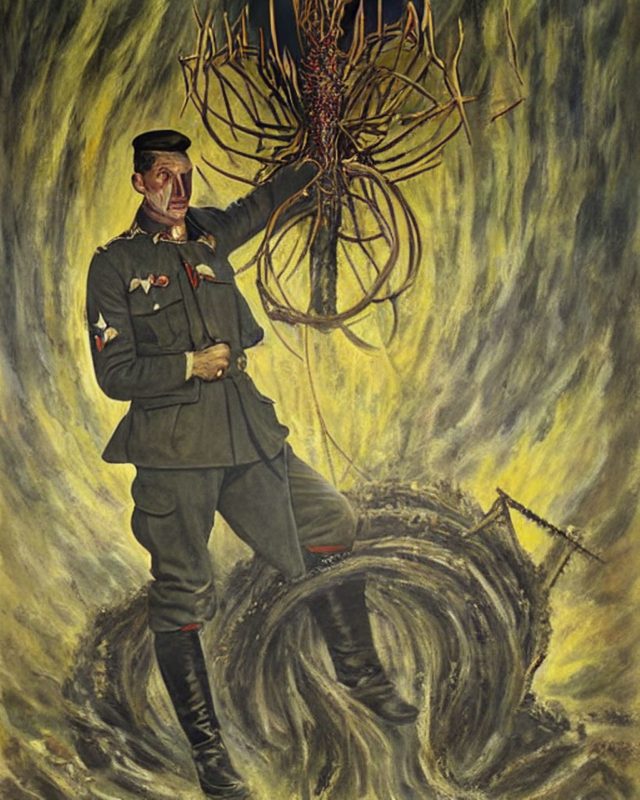
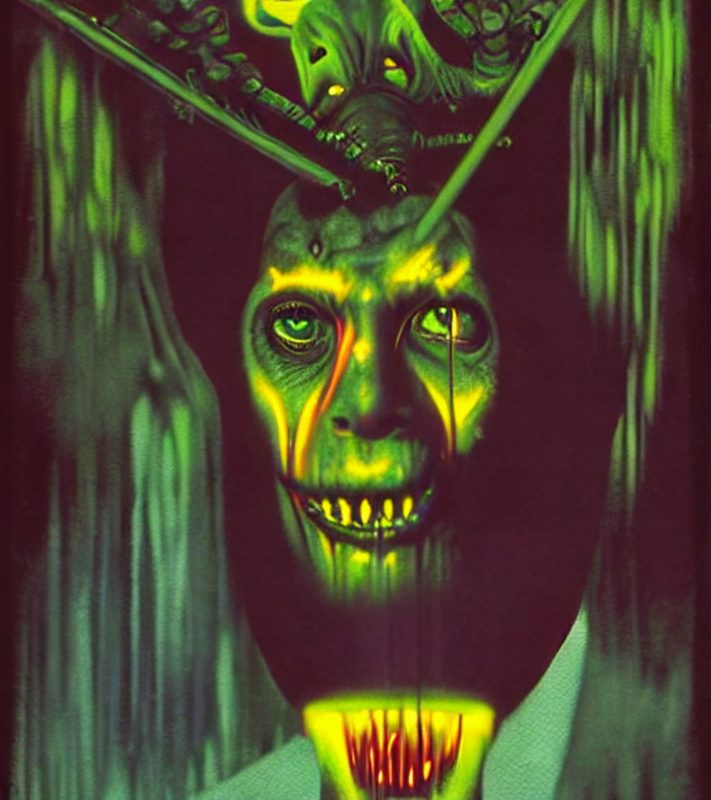
The Repairer of Reputations is a Trail of Cthulhu scenario by Robin D Laws, based on the story of the same name by Robert W. Chambers. It is one of four short horror stories incorporating Chambers’ mythology of The King In Yellow, a decadent play whose publication brings madness and supernatural presences into the world. His mythology was later subsumed into the Cthulhu canon when H. P. Lovecraft, and his circle and later followers, made reference to it in their tales of the mythos.
This scenario allows the players to recreate an alternate version of the story, in which their characters, who do not appear in the original, confront the nation-shaking conspiracy of its central villains. They either destroy it, or are destroyed themselves.
A seemingly utopian future takes on a distinctly nightmarish quality. The scenario plays with this by suggesting that the publication of The King in Yellow has warped history in a disturbing direction. The alien beings described in the play are as real as the antagonists believe them to be. They want their literal heir of Hastur, Hildred Castaigne, to ascend to the Imperial throne of their America—Hastur’s America.
Related Links
- See the complete reviews to date here.
| Stock #: PELGT23D | Author: Robin D Laws |
| Artist:Jerome Huguenin | Pages: 44 pg PDF |